Friday, 29 March 2013

Winter 2012-13

Another tree-planting push, this time almost all figs.  Fortunately several of the places were prepared last year, so didn't have to dig all of them.  Mostly they went in along a rocky ridge, using natural pockets in the rock, building mini-terraces where necessary.  The hard part was protecting them against sheep - proved very necessary last summer.  In most places there was not enough depth of soil to simply drive the stakes into the gound, so I ended up with some rather crazy staying, using lengths of wire attached to rocks, pine trees or anything else reasonably solid.

Also put in a couple more oranges: a canoneta, originally from Soller, and a de la sang (blood orange), plus another hass avocado to replace one that died.  The blood orange is supposed to be a Balearic variety but, according to the label, this one comes from Sicily.  I'm having another go with that cyprus-lined lower terrace, and will try to give the trees extra food and water and just see what happens.  I suspect that my problem with citrus there might have something to do with not watering frequently enough, not feeding enough, and sheep attack.  I hope they are now properly protected against the latter.

The veg garden was this autumn was an interesting experiment in just leaving it, as I was away for most of October and the whole of November.  Rainfall was good; frequent but not torrential, and temperatures mild. In December I still had cherry tomatoes and chillies, nice fat leeks, salads and lots of bok choi.  The bok choi is amazing.  Some was planted where it gets no more than an hour and a half of sun, and it still grew back from cutting to a re-cuttable size in five weeks.  Admittedly the temperatures continued to be higher than average right through December, but I was really surprised at the growth rate given the lack of sun.  Havas also coming along nicely, seeded before departure in October and left to their own devices.


The amazing bok choi

As mentioned in the previous post, the veg garden, which is usually the scene of rather more activity, was pretty much left alone this winter.  Star of the show really has to be the bok choi; I had not realised just how much of this vegetable you can get from just one sowing.  The trick is to cut it off above the main growing point, about 5cm above the ground.  If you cut lower, it will grow multiple heads instead of one new head.  In this case it was sown in September, first cut five to six weeks later, then again in December.  To my amazement, despite being in a spot where it received barely a couple of hours direct sun at that time, it grew again in a few weeks.  A third cut in January was just as tasty as the first two.  Then, on a brief visit in February it was all flowering: lovely, tender, broccoli-like flower heads.  The stems have a rather fibrous skin, but once is removed, it is similar to stem lettuce or water chestnut.  So, four harvests from one lot of plants.

In this particular instance, I think the success is due to giving the plants a nitrogen-rich feed after each cut, repeated after heavy rains may have leached out the nitrogen.  The fertiliser in question involves zero carbon footprint, minimal effort and is sterile: human urine, diluted about 1:5 in a watering can.  Application about 1 litre (urine) per square metre.  I follow it with some plain water, but don't know if this is necessary.  I always made sure that the soil was already moist, as a potential disadvantage of urine is that it contains some salt.  It has to be less than 24 hours old, otherwise it acquires an unpeasant ammonia smell.  I never noticed any odour after using urine, either on plants or on the compost heap (it acts as a compost accelerator).

I must confess that the variety in question here is mei qing, which is an F1.  Another F1, joi choi, was far less successful and anyway less tasty (I think this one does better if it's really cold).  For this year I have a couple of open-pollinated varieties to try, bought from the Real Seed Company.  If you're curious about what to do with bok choi in the kitchen, I'll be posting some recipes on the companion blog over the next day or so.


Wednesday, 6 February 2013

Oxalis pes-caprae: friend or foe?

I knew that this plant, known as vinagrella in Mallorquin, was not a native but an introduction from South Africa, but I did not realise that in California and Australia it is regarded as one of the most invasive and problematic weeds.  I was also labouring under the illusion that it was a nitrogen-fixing legume, which it is not.  In Majorca it is often seen forming a dense covering under citrus trees, and seems to be encouraged by autumn ploughing.  It grows on my lowest terrace, and appears wherever the ground has been disturbed, particularly in the damper, shadier spots.

It is regarded by some as a good thing in orchards, presumably because it competes with invasive grasses.  Now that I realise it's not a legume, clover would be preferable, but probably very difficult to establish once Oxalis is there.  According to this paper,  http://www.ncbi.nlm.nih.gov/pmc/articles/PMC2802929/ , based on  field research in Menorca, Oxalis pes-caprae can increase the availability of phosphorous, which certainly sounds like a good thing.  It also appears to be a poor competitor of rye grass.  So, in the case of my land, these are the conclusions:

1. I probably can't get rid of it from where it is already established, except by solarising or sheet mulching,  so just accept it where it is growing for the moment.

2. Don't encourage it to spread to other areas, rather work on establishment of leguminous ground covers such as Medicago truncatula (already present in places) and white clover.

3. Don't do autumn ploughing.  Actually, I don't do any ploughing anyway and don't intend to.

Friday, 9 November 2012

The Long, Hot Summer of Sheep

Not my sheep.  I didn't know whose, but I learned a thing of two about these beasts over the course of the summer.  First, they are not as stupid as they appear.  When it comes to getting at lush, green vegetation while all around is dry, they are pretty determined and resourceful.  Second, they are prepared to take reckless leaps down vertical drops of up to four metres to grab a meal of bean plants and citrus leaves.  And third, once they know where to come, they are very difficult to keep away.

So it went all summer; periodic stripping of the vegetable garden and trees, hasty erecting of fences, dawn vigils to chase off the intruders, lightning raids from unexpected quarters.  And, ahhh, a fatally injured young sheep.  Souvlaki, shwarma, curry, and meat to share around.

The odd thing was, no-one appeared to know who they belonged to.  On one occasion I managed to get them penned up - all except the ram that is - and called the policia local.  They said they'd call the appropriate department and call me back.  They didn't, and meanwhile the flock escaped to join the ram, who was happily browsing my peach trees.  Incidentally I learned that this can be quite a dangerous animal; the origin of the verb to ram something.  Not one to turn your back on in this vertical terrain.  Eventually they did enough damage to the garden of some better connected neighbours that the owner was identified and the animals securely fenced in.

The upshot is that I got a good fence round the core area of pip and stone fruit, citrus and veg garden.  I didn't actually lose any trees, though the growth of some was set back a bit.  And I have almost enough individual tree fences for the figs I plan to plant this winter, outside the fenced area.  Since they did not eat aubergine plants (too spiny), I got to experiment a considerable amount with the king of vegetables - this year I just had the Mallorquin black ones, but ten plants produces a lot of fruit.

In the tree department, all the new pip and stone from slow food did really well, as did the figs.  A few figs sourced elsewhere, mainly because they were cheap, were a mixed bag, some failing to sprout at all.  We even had some fruit from the coll de dama blanca planted last year.  A problem on the lower terrace though: the cyprus trees are proving tough competition for the citrus I planted, sending up roots where the water is.  I know this because my two avocados failed to survive February's freeze and, when I dug them up, there were the cyprus roots.  I also noticed that the citrus seemed to be getting thirsty quicker than in their first year.  Not at all sure what to do with this terrace.  I thinned the cyprusses, which looks better, but don't want to remove them as they look good and block the view of some ugly houses on the Muleta hillside.  As a windbreak they are ridiculous, tagasaste would be much better, but they do look classical.  Will have to think about this one.

Sunday, 10 June 2012

Spring

Well, into summer now, temperatures in the high 20s and not a drop of rain since April.  The trees are all doing fine, currently giving the new ones about 60 litres of water every 10 days, the one year olds about 200 litres every 20 days.  This is all very much going by the seat of my pants, probably erring on the side of caution, ie watering more frequently than necessary.  The citrus and avocados I'm doing once a week for all trees.

In April, while I was away, about a dozen sheep had a good go at the place.  They ate all the veg garden, except aubergine and courgette plants, and had a good browse at some of the trees, especially the citrus.  Thanks to help from my neighbour, we got a fence up fairly quickly, which should keep them out (goats would be another matter).  Now trees are mostly recovered, and it's been an interesting experiment in starting the veg garden late using starts.

Saturday, 14 April 2012

Ground cover

Here is one kind of ground cover that's almost grass-free, near the newly planted citrus trees. I did nothing to encourage it other than rather trample the area. Bill Mollison emphasises the importance of changing the ground cover vegetation under fruit trees from grass to leguminous and herbaceous plants. I suspect that the grasses of subtropical eastern Australia are even more of a menace than what we have here, but these are hard enough to get rid of. So I haven't tried to get rid of them other than in the dug areas around trees, and instead just seeing what grows where, and pulling the grass up to use as much (before it sets seed).

On the citrus and avocado terrace, vinagrella was present at the start but has colonised some of the dug areas, particularly where there is some shade. I'm not sure what this plant is, but I understand it's introduced from South Africa. Anyway, it can make a lovely grass-free carpet under citrus trees, usually where there is dew such as in the horta de Soller.

Friday, 30 March 2012

Spring


After being away for a month until mid-March, there was a bit of work to catch up on. Rainfall-wise things are still a bit dry, but the soil 20cm or so down is moist. The new trees are all sprouting except, lol, the two non-Mallorquin figs. The need for more mulch material is considerable, and I think the best recourse might be to buy a few bales of straw at 3 euros each. I noticed while preparing the veg beds that the soil which had been mulched with straw is looking darker than that mulched with leaf litter. It's also nice and easy to apply and stays on ridges rather than slipping off.

I had 30 odd asparagus plants, and only 17 would fit in the bed prepared the traditional way, dug deep, manured, pffff! So, to see how necessary all that effort really is, I put half a dozen in a hastily dug and manured bed between fruit trees, and left some in place where they were planted as seedlings. Now all we have to do is wait a few years and see which produces most.

It's been interesting to see what's happening with ground cover. The biggest enemy, I think, is a grass whose name I do not know but which looks very similar to what is known as chien dent in southern France. It's invasive, wiry, ugly and covered much of the property until two years ago. Actually, it still does cover quite a bit, but fortunately it's proving less hard to get rid of than I had feared. It doesn't seem to like disturbance, or perhaps disturbance favours the other plants that compete with it. In any case, quite a bit of the ground is now being covered with cuckoo pint and various small leguminous plants.

Also on the subject of ground cover, the lovely rock rose Cistus albidus has been appearing all over the place. I've tried to weed carefully around the little plants and mulch them, and have also clipped some of the bigger ones to make them grow more bushy. They are flowering nicely now. Along with cuttings of lavender, rosemary, Senecio, Euphorbia, and other drought tolerant herbaceous plants, I'm trying to get the ground between the trees covered so that the grass is kept in check. It should look a lot nicer too.

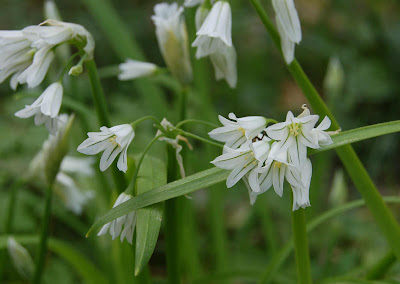
The little white flowers of Allium triquetrum are multiplying nicely on the shady side of the house. The leaves are not as palatable as those of garlic chive, but it should eventually form dense enough cover to supress grass.