Saturday, 5 February 2011

Mainly trees


Such work as has been done since the last posting has involved some very old olive trees, medium-sized pines and very small fruit trees. Also taking stock of more shifting terraces and fire hazards. The first pic shows an olive from which decades-old suckers have just been removed. It needs pruning too, but that will have to wait until next year. In this case the terrace collapse seems to be due to the tree, which is also stopping it from going further. Some other walls are showing the bulge which means real collapse is in the offing. They can go on for a very long time looking bulgy, but at least one moved disconcertingly after a
recent heavy rain. There is a slight bulge just to the right of the beautiful steps which lead to the lowest terrace. These are all angled inward, giving you a much greater feeling of security than the narrow steps would otherwise.
Several olives were very overgrown with suckers. Unfortunately a pine just above one of these fell the way it wanted to rather than the way I tried to get it to fall, and broke one of the two remaining good branches. The older suckers are up to 15cm in diameter, and are the preferred material for fence-posts.

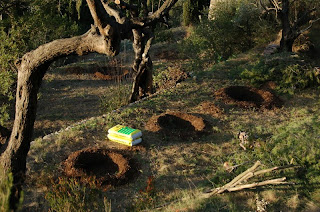
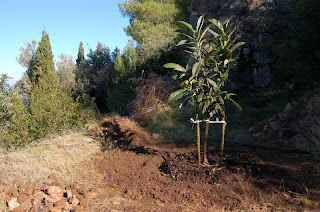
Having finally cleared the space, doing a spot of pruning of carobs as well, it was time to dig a few holes. These were not too hard after some rain, and could pretty much all be done with the two-handled fork. I worked an area of about 2m in diameter. working the soil first from the outside in, making a mound, then from the inside out to make a crater. I tried to dig the middle a bit deeper, but the ground becomes extremely stony below about 40cm. As there is have no really composted compost to hand I used some bagged stuff to condition the soil. From the verges of the Alconasser road can be scraped some nice encina semi-compost which was applied as mulch, but it is full of not yet decomposed acorns and leaves, so I thought best not to dig it into the soil. First to go in were 3 nectarines, all new-ish varieties: fantasia, snow queen and red glover. Also a kaki fuyu, a loquat (argelino) and one fig, coll de dama blanca. I'm hoping to put in quite a few more figs next year, sourcing them from among the 40-odd old Mallorquin varieties distrubuted by Slow Food Baleares in collaboration with Vivers Llabres in Manacor. You have to order them now for next year, which I've done along with 3 apricots, 3 apples and a plum, all old varieties from Mallorca or Menorca. The standard apricots on offer are commercial varieties grown in inland areas of the peninsula, which makes me suspect the chill-hours here may be insufficient.

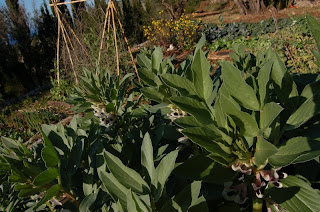
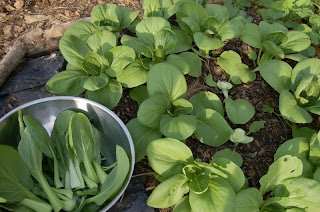
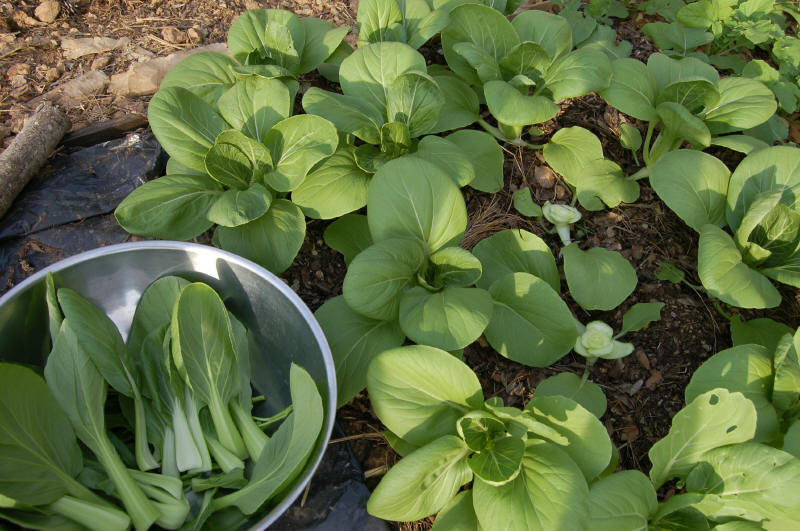
Veg garden somewhat neglected, but some greens to be had. At mid-winter all but the inside ends of the beds got 4 hours of sun, now it's up to 5. With mostly mild as well as some chilly weather, bok choi and komatsuna seeded mid-November now ready to eat. Broccoli is still going, the hybrid green spear producing best. September sown peas still producing a few, while November sown ones have a first flowers. Havas have lots of leaf and flower, but pod-set has not been great - hopefully it will improve now that more sunshine has brought out some bees.

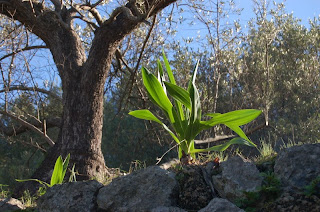
The creation of any sort of aesthetic garden has been small and slow, but clearing has revealed some nice plants that were hidden by the tangle of wire-grass. The sea-quill, Urginea maritima, was growing right along the edges of a couple of terraces. The leaves dry up in summer and it forms an enormous bulb, up to 1kg in weight, from which a spike of white flowers bursts at the end of summer when all around is dry. There is also an abundance of the beautiful heather Erica multiflora. Having enjoyed the mauve flowers until the year's end they are now a rust-red. Much of it is leaning outwards from growing under pines, but I have noticed it grows back vigorously after being cut. Also discovered some bee orchids at the edge of another terrace, mow in flower. There's lots of lentisc, Rhamnus and Cistus, and a few Arbutus, all nice plants to have around. The only things I am trying to get rid of completely are bramble (one small plant found) and spiny broom. Smilax aspera is too prevalent to hope to eliminate, so will probably just have to keep pulling up (or down) this hook-spined climber from time to time.


Monday, 13 December 2010

December - dealing with flammable stuff

So far fortunately much cushioned from the early cold that's hit pretty much all of Europe to some degree. Having finished with the pines for the time being, and strimmed a mess of tall grass and various spiny things fro the terraces, there is now the problem of a huge amount of material that is highly combustible and will be even more so in the heat of summer. The trad thing to do is burn it, but this turning of organic matter into air pollution and alkaline residue is rather anathema. However it will take years to decompose and I don't have a shredder and cannot afford one now, so some burning is just going to have to be done to get rid of the fire hazard. Most flammable is the strimmed stuff, which is also nasty and spiny, and full of grass seed, so this seems like the thing to burn. It's also light and easy to move. The pine branches are another matter - the plan is to divide into the cut branches into stuff big enough to burn in the
stove, and the twigs and needles. The latter could be spread around as long-term mulch or path surfacing (for which I've been using carritx, but have a limited amount). There's an enormous amount of this pine , so it will have to be done a little at a time. No pics of strimming and sawing, so here are a few from a walk a few hours from the house on the way to the Gap Gros lighthouse


Saturday, 20 November 2010

November: wind

Since the deluge of early October it's been a pretty dry month with just the odd shower but quite a lot of wind, mostly westerly. Temperatures now down to about 10C at night, up to between 12 and 14 by day. The centre of the island, by contrast, has a range more in the region of 7 - 16, with clearer skies and without the moderating effect of the sea.

Most of the time I've had to work on the land has been clearing of one sort or another. My uphill neighbour, or rather his tenant, has given me
permission to clear pines on his land, and I've
been trying to get as much done as possible in case his landlord doesn't agree. It's a strip of olive groves all along above the house, getting colonised by pines which are now up to 25cm trunk diameter. They can be cut easily now, but if allowed to get bigger there's the danger of damaging terraces when they are felled. The olive trees are very neglected, but there is also other vegetation growing up: encinas, arbutus, mastic and lots of giant heather. By removing the pines the encinas have a chance to take over, rather than getting yet another pine wood, in this case one that would eventually overhang the house
and much of the land.

Veg doing OK, but discovered the peas I have grow much taller than indicated and flopping all over the carrots. Zuccola wins on taste and not a bad cropper either, on a par with the regon and way ahead of norli. Cut a few reeds for the next lot to try and keep them upright. Broccoli, all varieties, heading up, but the green spear and gai laan more productive than the regular calabrese. Chinese cabbages turning out mostly OK but a bit slug and caterpillar mauled. Daikon are huge and un-mauled, and cos lettuce sprouting back nicely after being cut. In the past I had followed advice of an older gardening book and always pulled up whole lettuce, but the cut and come again approach seems to work fine on this variety (Batle lechuga rubonea).

Friday, 15 October 2010

October - rain


After a little bit of rain in September the first serious deluge came in the first week of October after a week of warm, muggy weather. A front came through with electrics, wind and downpour, and the ensuing weather system spent the next week revolving more or less around the Balearics. So now the second spring is well under way, grass is growing almost fast enough to watch, insects are buzzing and all the other pests have woken up. Not just grasshoppers now, there are some rather destructive caterpillars that eat out the growing points of radishes and others eating the leaves (not cabbage whites). Also slugs, particularly on the chinese cabbages. Weeds: the main ones are wild asparagus and lords and ladies which are coming up everywhere from corms. Very decorative but still weeds when in the veg beds.


Things are growing and there has been more to harvest. The beans cropped well but now seem to be fading off, peas are going - norli turns out to be a miniature pea, tasty but a lot of work to pick. We have a good supply of lettuce, spinach, mizuna, bok choi, daikon, spring onions and coriander, with broccoli, chinese cabbage and stem lettuce looking close to ready. Trying to keep everything well mulched to protect soil from rain and wash in some organic matter, using a mix of pine needles and encina (holmoak) leaves.

Put in the first havas (broad beans) at the end of september, a bit earlier than traditionally done here. Will try some more in this month wherever there is space as they are good nitrogen fixers. With nice big seeds hopefully I can involve the kids in seeding them.


Sunlight beginning to get a bit short now. Having cleared a few of the big pines behind the house things are a bit better, and most of the beds get six hours or so of afternoon sun but the inside ends rather less. Temperatures dropping to a typical range of 14-20, but due to go a bit lower in the coming week.


Friday, 10 September 2010

first month


About 5 weeks now and some sort of start on the veg patch. Sheet mulch probably didn't have long enough to work properly, or rather process was cut off by onset of summer drought. Grass underneath seems to be dead but by no means decomposed, and wild asparagus very much alive and pushing through everywhere. Ground below is hard - loosening up the top 30cm or so involves first breaking it up with a pick-axe, then working over several times with the two-handled fork. Slow work, about one square meter an hour, including getting the masses of wiry roots and larger stones out. That leaves small stones and some reddish soil with a bit of organic matter from the sheet mulch. Much of the latter is undecomposed and re-used to mulch some of the beds not done in February. Roots, mainly of caritx (a tall clumping grass) and wild asparagus, piled up to use as mulch for perrenials. What to do with all those stones? The widespread answer in limestone country is to pile them up, so doing this at ends of beds. Started by edging beds with planks, then ran out of planks and just raked up a raised section. One bit edged with a pine log seems to work better than planking, maybe this is the way to neaten them up.

First things to go in were dwarf beans using some seed left-over from France, spring onions, carrots, and pots and trays of chinese cabbage, bok choi, lettuce and broccoli (centaur, green spear and gai laan). Followed a little later with direct sowing of daikon and beauty-heart radish, and 3 varieties of peas (oregon sugar pod, norli and zuccola). A bit more of the same over the following few weeks, plus some spinach, hon tsai tai, mizuna and a late try with parsley. Last in, today, trays of komatsuna and a few each of 2 tpes of mustard greens (green in snow and osaka purple). The green in snow was one of the few things to survive last winter in the Cevennes and was much appreciated, but a little goes a long way. With all of these I used some organic fertilizer (NPK 7-6-7) to kick start things, as such organic matter as I have added is not likely to have much food in it, being mostly leaf and pine-needle mold.

Most things grown quite well so far. Watered every day until recently when some things seemed OK with alternate days as it gets a little cooler and they get established. Using our metered water carefully, not so much involved just to get things started. Pests: no flea beetles so far, touch wood. A few grasshoppers can chomp quite a few seedlings to the ground, with a prediliction for spring onions and coriander, but that's really about all so far. Spotted one hoopoe in the patch, would love to have it as a regular but perhaps the pickings are not that great.

First thing edible was the bok choi (mei qing) ready after 35 days. Daikon thinnings nice in salad, rather like rocket, which was another one of the first things to be eaten. Basil too but that was seeded in June before moving from France. Meanwhile we've been feasting on superb tomatoes at around 70c a kilo, with peppers and aubergines at a euro odd per kilo. The standard for summer veg is a hard one to match.

Friday, 26 February 2010

Whole Carob Pods, wild, 300g £4.95

It seems one could do better than the co-op when it comes to selling carob beans. I came across this link when, after writing the last entry, I thought I should actually learn a bit more about this crop as there are a good half dozen carob trees on our land. Having tried eating them though, I suspect that they will be slow to catch on as a snack food. In Mallorca the only references I've heard to humans eating them were in the context of famine.


The start of a veg patch - sheet mulch

A two week visit in February, and made the first steps towards establishing the veg patch. I've chosen the widest terrace and using the space between a large olive and carob tree, there is room for about 50 square metres of beds plus, at a later stage, about 10 linear metres for asparagus. Plans are for an "Indian garden", as in native American, further along past the big carob, rotating pumpkin, corn and beans. This would add a further 20 square meters or so.

There was also a smaller carob right in the middle of my chosen area. Feeling bad about it, but without seeing much alternative, I cut it down. There are some much bigger and finer examples on the land of this handsome but, I suspect for my purposes, rather useless tree. I once gathered half a dozen sacks of carob to take to the co-operative (it's used as pig fodder), and got enough pesetas for a small round of drinks. If anyone has any ideas what can be done with carob, other than making compost, mulch or not-chocolate, I'd be interested to hear.

I set out to prepare two thirds of the bed area, the bit I'm hoping to grow something on in September. I had thought of working it over with a fork and sowing green manure, but given the wiry tangle of grass and wild asparagus covering the ground, decided that sheet mulching was a better idea. A lot of work but hopefully fulfills 4 functions: getting rid of the perennial weeds, adding some organic matter, increasing the earthworm population and, given the amount of pine needles involved, nudging the soil pH downwards. In theory. We'll see in 6 month's time how well it has worked.

Anyway, once done with the obstacle in the middle and various stumps of ancient lemon trees from the times the land was irrigated for citrus, the real work started. Given the amount of schlepping involved, I decided to only do the beds, covering the paths with cardboard and some grass to make it look less ugly. Having tracked down a source of free horse manure - moltes gràcies Joaquín - I got 2 loads, in polythene bags in the back of the hire-car, in all about 250kg. I have read that around 2,5kg to the square meter is enough, but that seems to be spreading it very thin. Only doing 2/3 of the veg patch, I ended up using more like 7kg to the square meter.

Next the weed barrier. Getting what I could reach from recycling bins in the way of newspaper and cardboard, plus lots more cardboard from the back of the Eroski supermarket, I used about 4 sheets of newspaper to cover the beds and cardboard for the paths, plus the third of the patch which I didn't get to do this time (will be interesting to see if the covering alone gets rid of the grass).

The greatest bulk in the process is the mulch to cover the weed barrier. I used mainly pine needles, which form quite a mat under pines, the stuff underneath alredy quite well composted. I've heard some dismissive remarks made about pine compost, but it's there and should do a little towards lowering the pH. I also used a bit of encina (holm-oak) leaf mold, which is generally regarded as superior, bit only what I could get from the concrete driveway under some small encinas, so the bulk of it was pine. Having read that you need about a 15cm layer (Mollison, in Introduction to Permaculture), I got as much as I could, but in the end I think it was more like 10cm once it settled down.


Having finished the job in 8 days, doing a few hours every afternoon, I admired the work and took this pic. The bit on the left is only covered with cardboard to try and get rid of the grass, the plan being to only start working it in a year's time. Might try some green manure on it in the autumn. Now we just have to hope for plenty of rain over the next few months to get it all going before the summer drought. Total cost of the job: EUR 2.40 for a roll of 10 large poly bags. True I did have to make a detour of about 200m in the car, x 2, to collect the horse manure, so that adds something to the environmental impact of the op, but a minor one compared to the car journeys it was tagged on to.